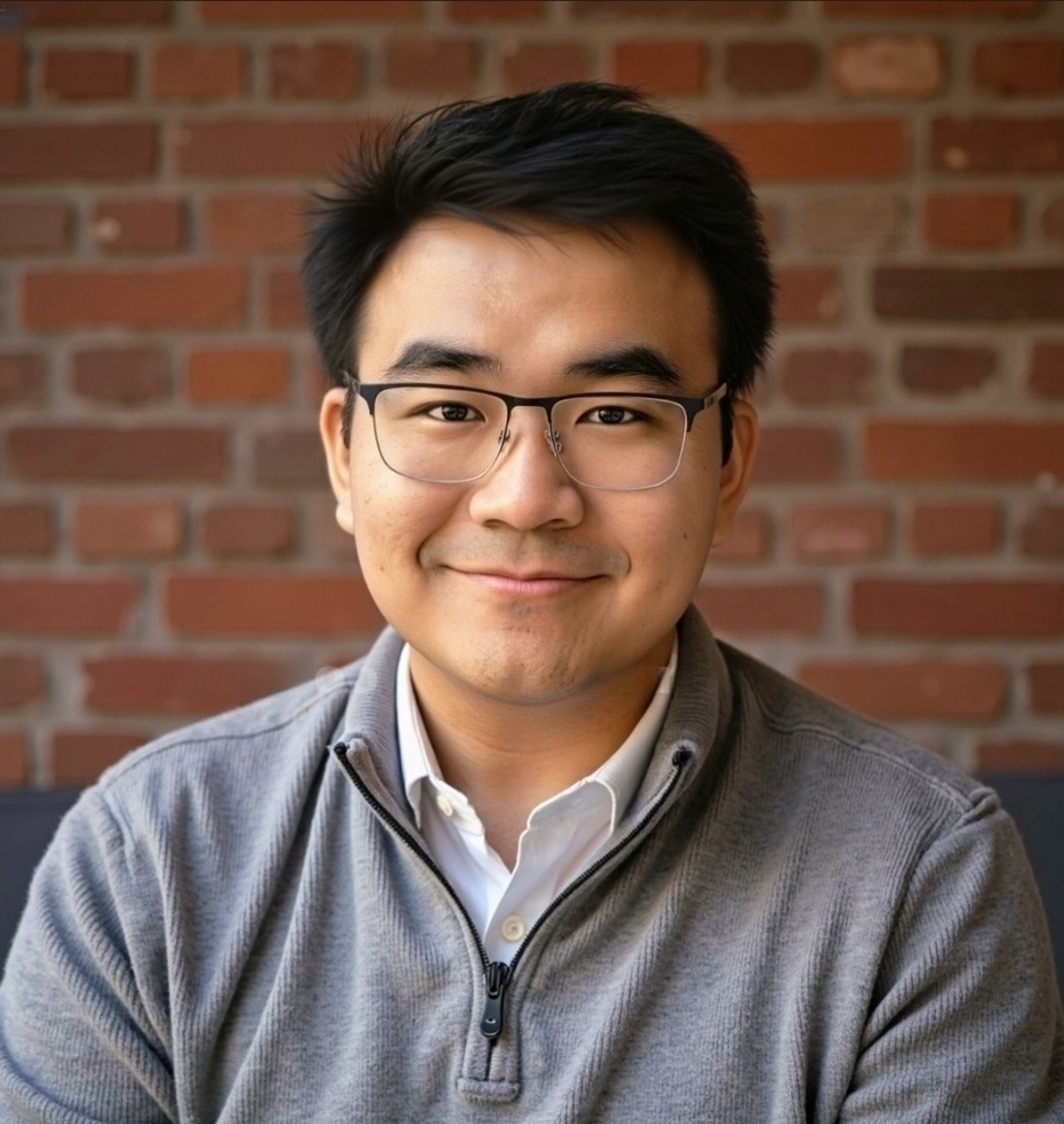
Columbia University Student Researcher

Swan Yi Htet

Undergraduate Researcher specializing in Applied Physics and Data Science. Exploring the frontiers of plasma dynamics and robotics.

About Me

Mission Statement

"To bridge the gap between theoretical physics and engineered systems, leveraging computational modeling to design intelligent, autonomous behaviors in the physical world."

I am an Applied Physics student at Columbia University with a research focus on computational modeling of physical systems. My work is grounded in plasma physics and nonlinear dynamics, where I develop reduced computational models to analyze collective behavior, stability, and transport in complex physical systems.

Alongside this, I am increasingly interested in robotics and autonomous systems as a natural extension of my training—particularly in how physical principles, control, and computation come together to produce intelligent, real-world behavior. I view robotics not as a separate discipline, but as a physical system that demands the same rigor as theoretical and computational physics.

My long-term goal is to work at the intersection of physics, computation, and engineered systems, contributing both to fundamental understanding and to the design of systems that interact meaningfully with the physical world.

Education

Columbia Logo 2025 - Present

Columbia University

The Fu Foundation School of Engineering and Applied Science

B.S.E. in Applied Physics
GPA: 3.9 / 4.0
Queens College Logo 2022 - 2025

CUNY Queens College

Magna Cum Laude

B.S. in Physics
GPA: 3.9 / 4.0

Scientific Portfolio

Research Experience

Focusing on Computational & Theoretical Physics

Wave-Particle Interactions and Reduced Simulation Models in Fusion Plasmas

  • Developing reduced simulation models (passive tracer and ∂f methods) for nonlinear wave-particle interactions in 3D magnetic field configurations.
  • Benchmarking and extending the Vlasov-Poisson bump-on-tail model.
  • Applying data-driven methods (SINDy, autoencoder latent space mapping) to build reduced-order models of particle transport.

Natural Swarmalators

CUNY Queens College

Supervisor: Dr. Oleg Kogan Dec 2024 - Jun 2025

Analytical and Computational Modeling of Natural Swarmalator Systems

  • Conducted analytical studies of potential swarmalator systems, extracting and validating specific parameters.
  • Designed experiments and computational models to bridge theoretical swarmalator frameworks with observed synchronization and self-organization dynamics.

Astro-computing Research

Supervisor: Dr. Keaton Bell Oct 2022 - Jun 2025

Stellar Variability and Exoplanet Detection using TESS Photometry and Gaia Catalogs

  • Observed photometric images of variable stars from NASA's TESS data to quantify uncertainty in light curves using MCMC analyses.
  • Implemented best-fit simulation models of TESS star pixel images using GAIA and TESS Input Catalog data to measure crowdedness.

Academic Outreach

Conferences & Presentations

Aug 2024 Flushing, NY

CIRE Research Conference

Hosted by CUNY Queens College

"Characterizing Crowdedness in TESS Images"

July 2023 Honolulu, HI

TASC7/KASC14 Workshop

University of Hawaii & TASC/KASC

"Characterizing Crowdedness in TESS Images"

Jan 2023 New York City, NY

GothamFest Workshop

Flatiron Institute & Simons Foundation

"Measuring Crowdedness in TESS Photometric Images"

Engineering Portfolio

Technical Projects

Autonomous Systems & AI Infrastructure
ORION Interface
ORION In Development

Omniscient Reasoning & Intelligence Operations Network

Personal AI Assistant System

A JARVIS-inspired AI assistant designed as a modular brain system for future robotics platforms. Built on a FastAPI/Python backend with extensible subsystem architecture. ORION serves as the central intelligence layer, orchestrating task planning, memory, and real-time decision-making.

Python FastAPI LLM Integration Agentic Planning
Built with David Young — University of Pennsylvania
Phase 1 Complete | Private Repository
ATHENA Mars Simulation
ATHENA Live

Autonomous Terrain & Hazard Exploration Navigation Agent

ORION Subsystem — Navigation Module

An interactive 3D rover autonomy simulator with real-time A* pathfinding visualization, infinite procedural terrain, slope-aware hazard classification, and a live 3D engineering viewport showing rover mechanics. Watch the AI think as it plans routes across planetary surfaces.

Currently deployed on Mars (Jezero Crater). Future environments — Venus, Europa, Titan, and more — will introduce unique atmospheric pressure, gravity, visibility, and terrain constraints, with adaptive autonomy that learns from each world.

React Three.js A* Pathfinding Procedural Generation fBm Noise
Built with David Young — University of Pennsylvania

Honors & Awards

Molly Weinstein Prize

For distinguished scholarship & intent to pursue a career in college teaching.

$5,000May 2025

Departmental Physics Prize

Awarded for consistent enthusiasm and dedication to physics studies.

$400May 2025

Phi Beta Kappa Honor Society

Inducted into the nation's most prestigious academic honor society.

Invited MemberSep 2024

Summer Research Program

Outstanding contribution to the Summer Undergraduate Research Program.

$2,000Aug 2024

Michael Craig-Scheckman Award

Recognition for impactful collaboration in intensive research.

$750Jun 2023

Technical Arsenal

Languages & Frameworks

Python C++ Java JavaScript MATLAB Mathematica React FastAPI Three.js HTML/CSS PIC Assembly

Computational & ML

NumPy/SciPy PyTorch MuJoCo SINDy Reinforcement Learning Monte Carlo Methods Autoencoders Qiskit

Tools & Infrastructure

Git Docker Linux/Bash NERSC HPC LaTeX Conda VS Code

Domain Expertise

Plasma Dynamics & Fusion Nonlinear Wave-Particle Interactions Robot Kinematics & Control Autonomous Navigation Astrophysical Data Pipelines Dynamical Systems Reduced-Order Modeling Mechatronics Quantum Computing

Get In Touch

Currently open to collaborative research opportunities and academic discussions. Feel free to reach out via any of the platforms below.

Start a Conversation